
Places let you track points of interest — whole worlds down to a single inn — and nest them inside one another (a tavern within a city within a kingdom). Places are a paid-tier feature. The index offers three views: Card (top-level places you click into), Table (a flat list of all places), and Accordion (a collapsible nested tree you can also drag to reorder).
Creating, editing, and deleting places requires the Cartographer role (Game Masters and Game Owners are Cartographers automatically). A place marked Secret is hidden from players, along with any places nested inside it.
 Chronica places main screen
16.1 Creating & Editing Places
Cartographers create a place with the blue "New Place" button, or the green "+ Place" button on a profile to make a child place. The form covers:
- Name and an optional Parent Place (leave blank for a top-level place) and Location detail.
- Game Master Settings (GMs) — a Profile Template and a Secret? toggle.
- Custom Stats — places support stat groups just like characters; text stats are editable here, and checkbox/option stats are edited on the profile.
- Description and Notes, plus a Game Master Secrets editor (GMs).
- An image (up to 5MB; about 800x400px landscape works best).
To edit, use "Edit Place" on the profile or "Edit" on any index row.
16.2 Place Profiles
A place's profile gathers everything about it. The details card holds its image, location, custom stats, and a Links section (to domains, map tiles, and any custom links). Other panels list nested Places, linked Characters, Quests (visible to all players), and — for Game Masters only — Encounters. There's also a Developments panel, and full Description, Notes, and GM Secrets sections. Cartographers can add child places, character connections, and links right from here.
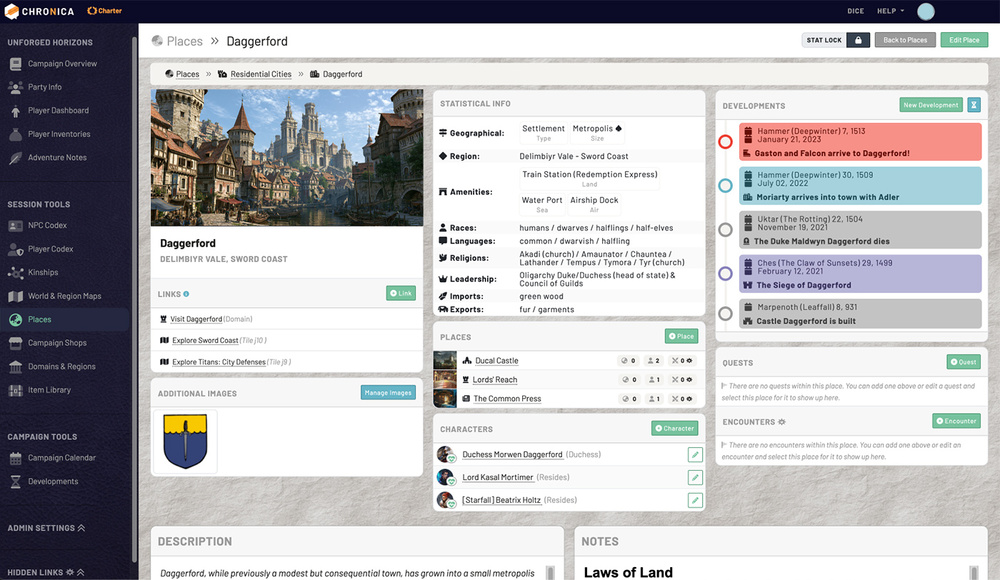 Place profile screen