
The Campaign Overview is the front page of a campaign. It is what you and your players see first when you open the campaign, and it answers the questions people ask most often: what is this campaign, who is in it, and what is happening next.
It is also where Game Masters reach the campaign's settings.
The buttons at the top
Players see the campaign name and nothing else here. Game Masters see a row of buttons:
- Edit Campaign — opens the campaign settings. Covered in 4.2.
- Campaign Subscription Settings — the Game Owner only. Covered in 3.0 Subscriptions & Payments.
- Want to leave this campaign? — shown to players who are not the Game Owner. It takes you to your own player settings, where the Leave Campaign button is at the bottom.
About
The large card on the left holds your campaign's header image, an optional video, and the About text. This is the description your party reads, so it is worth filling in. Until you do, the card says there is no About content yet, and Game Masters are pointed at the Edit Campaign button.
You can use @ mentions in the About text to link to a quest, character, kinship, place or entity. If you mention something secret, players who cannot see it get a placeholder naming the type instead of the name — for example [Character Unavailable] or [Place Unavailable].
Quick Info
The card on the right summarizes the campaign. Everyone in the campaign sees:
- Game Owner — who owns the campaign, with their avatar.
- Game System — whatever the Game Master entered, for example D&D 5e or Call of Cthulhu.
- Created On — the date the campaign was made.
- Subscription Tier — the current tier. For the Game Owner this is a link to the subscription page.
- Players — how many players the campaign has, and how many the tier allows, shown as a number out of a number. The Game Owner also gets a Need an Upgrade? link, unless the campaign is already on Deity.
- Storage Used — a bar showing how much of the campaign's storage is in use.
Game Masters see two extra rows: Download JSON with a View Options link (see 4.3), and Activity Log with a View Log link. The Activity Log records what has been added, edited and deleted across the campaign, and only Game Masters can open it.
Links
At the bottom of the Quick Info card is a Links list, for anything useful that lives outside Chronica or elsewhere inside it. A shared map image, a house-rules document, a music playlist, a character sheet — anything with a web address. Players only see this list once it has at least one link in it.
Game Masters add one with the green Link button. A link needs a Title (what your players will see) and a Link URL. The URL must include the full address with http:// or https:// at the start. There is also a New Tab? setting, which decides whether the link opens in a new browser tab or the same one.
Once a link exists, everyone in the campaign can see and use it. Game Masters get a pencil button next to each one for editing or deleting. Links always belong to the campaign you are in — they cannot be added to a different campaign.
Next Event
Shows the campaign's next scheduled session, with who created it and how many people have confirmed. View Events opens the full calendar. If nothing is scheduled, the panel says so. See Events & Attendance for how scheduling works.
Players
Everyone in the campaign, with a die icon next to the Game Owner and a dungeon icon next to each Game Master. A padlock next to a name means that player is locked out of the campaign, which happens when a campaign has more players than its tier allows — see 3.3. Party Info opens the full roster, shared wealth and party inventory (6.0).
 Chronica Campaign Overview screen
4.1 Creating a Campaign
Making a campaign takes about ten seconds. Chronica asks for two things and lets you fill in everything else later.
- Open your User Dashboard.
- Click the green New Campaign button in the Campaigns panel.
- Enter a Campaign Name. You can change this at any time.
- Enter a Game System — for example D&D 5e, Pathfinder, or Call of Cthulhu. This does not change which tools you get. It helps us decide which features to build next.
- Click Create Campaign.
You are taken straight into the new campaign, and you are its Game Owner and its first Game Master.
What you start with
A new campaign begins on the free Peasant tier, using the Classic theme, with cloning turned off. Chronica creates your personal inventory and the shared party inventory for you.
Everything else is empty on purpose. There are no starter currencies, no calendar, no stat groups and no default folders, because those are the parts every table sets up differently. Build them as you need them, or copy them from a campaign you already run — see 5.0 Cloning Campaign Data.
 Create a new campaign button
 Chronica Create a new Campaign screen
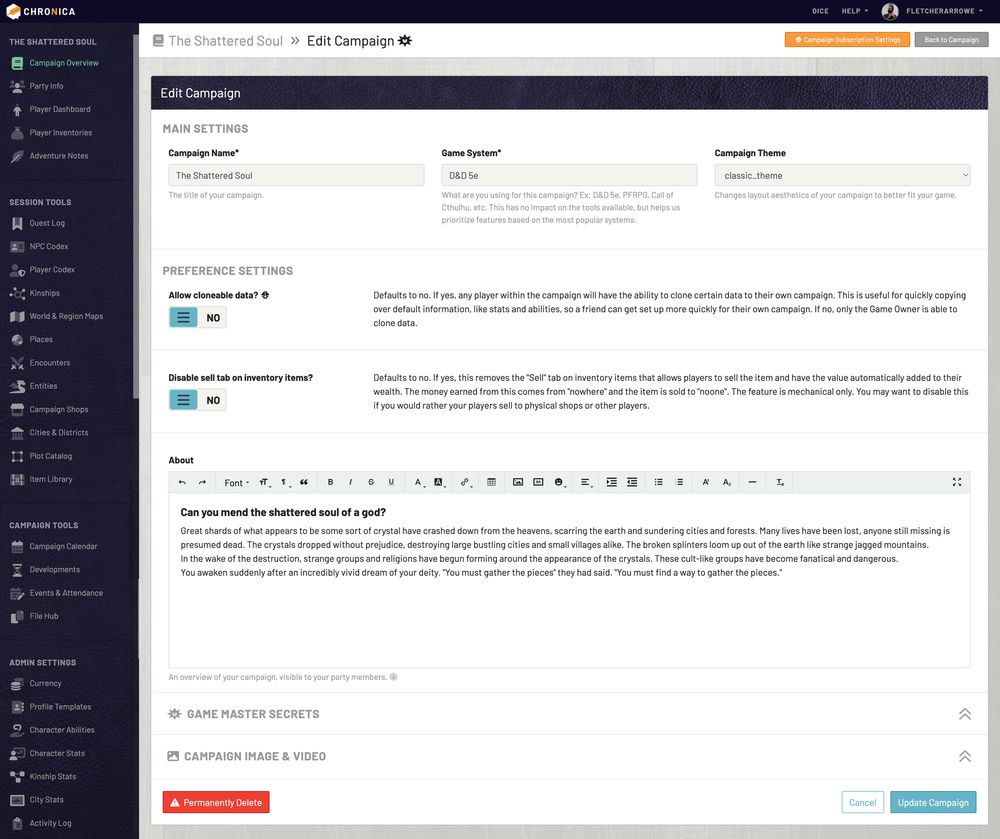
4.2 Campaign Settings
Game Masters open the settings with the green Edit Campaign button on the overview. Everything on this page saves together with the Update Campaign button at the bottom.
Main Settings
- Campaign Name and Game System — both required, both changeable at any time.
- Campaign Theme — choose Classic Theme, Nebula Theme or Blacklight Theme. This changes how the campaign looks for everyone. Each player can override it in their own player settings if they prefer a different one.
Preference Settings
Allow cloneable data? — off by default. When on, other players can copy certain parts of this campaign's setup into their own campaigns, such as stat groups or an item library. This is useful if you have built a set-up you want to share. When off, only you can clone from it. See 5.0 Cloning Campaign Data.
Disable sell tab on inventory items? — off by default. When on, it removes the Sell tab from inventory items. That tab lets a player sell an item and add its value to their wealth automatically, with the money coming from nowhere and the item going to nobody. Turn it on if you would rather your players sold things to real shops, to each other, or not at all.
Filter the left navigation — a list of features you can tick to hide from the left-hand menu. Useful if your campaign does not use, say, Kinships or Domains, and you would rather not look at them.
About and Game Master Secrets
About is the campaign description your players read on the overview page. Game Master Secrets is a separate box that only Game Masters can see, in a collapsed panel below it. Both accept formatted text and @ mentions.
Campaign Image and Video
Under Campaign Image & Video you can replace the default header picture and add a video.
- Upload Image — accepts .jpg, .jpeg, .png and .gif files up to 3MB. Landscape pictures work best, and around 600 by 300 pixels is a good size. Tick Remove current image to go back to the default.
- Video Link — adds a video to the overview page. If you have a video but no uploaded image, the video replaces the default picture. If you have both, the video appears below the image.
https://www.youtube.com/embed/KJWoyM1Q1tw or https://player.vimeo.com/video/4132816. A normal YouTube watch address will save without any error and then show an empty box on your overview page. If your video is not showing, this is almost certainly why. Edit campaign button
 Chronica Edit Campaign screen
4.3 Backing Up Your Campaign
Game Masters can download the campaign's data as JSON files, one section at a time. Open it from Download JSON: View Options in the Quick Info panel.
The options page lists each section of your campaign with its own Download JSON button. The sections are Abilities, Adventure Notes, Campaign Shops, Characters, Developments, Domains & Regions, Encounters, Entities, Events, Kinships, Master Item Library, Places, Players, Quest Log, Regional Maps, and Stat Groups & Stats.
Two things to know before you rely on it
Reading the files
JSON is a text format, so the files open in any text editor, but they are much easier to read in a JSON viewer, which shows the content as expandable layers. There are also free tools that turn a JSON file into a spreadsheet if you would rather work that way.
4.4 Deleting a Campaign
Deleting a campaign removes it and everything inside it, permanently. Because there is no way back, Chronica asks you to confirm in a deliberate way.
How to delete a campaign
- Move the campaign to the free Peasant tier first if it is on a paid tier. The delete option only appears on the free tier. Changing tier also stops the billing — see 3.2.
- Open Edit Campaign and click the red Permanently Delete button at the bottom.
- In the window that opens, type the word
deleteinto the box. The red Confirm Delete Campaign button stays greyed out until you do. - Click Confirm Delete Campaign.
What happens to your players
Your players' user accounts are not deleted — their Chronica accounts are untouched, and any other campaigns they belong to are unaffected. What they lose is everything they made in this campaign: their characters, inventories, notes and wealth all go with it. Tell your table before you delete a shared campaign.
4.5 Changing the Game Owner
The Game Owner is the person who created the campaign. They hold its subscription, and they are the only one who can change the tier, delete the campaign, or lock and unlock players.
Ownership cannot be transferred inside the app. There is no setting for it, and a Game Master cannot be promoted to Game Owner. If a campaign needs a new owner, email support@chronica.ventures with the campaign name and who it should move to, and we will arrange it.
When you might need this
- The person who created the campaign has stopped playing, and someone else is running it now.
- A different person is going to pay for the subscription.
- You are closing your Chronica account and a campaign you own should carry on without you.