
An inventory is a list of items. Every player has their own Player Inventory, and the party shares one Party Inventory. A character with an ownership has its own inventory too (see 8.0). Shops, kinship caches, quest loot and encounter loot are also inventories, and they have their own guides.
In an inventory you can keep items in containers (9.1), add and edit items (9.2, 9.3), use, sell and split them (9.4), and give them to other players or move them between inventories (9.5).
Opening your inventory
Click Player Inventories in the sidebar. This opens your own Player Inventory. If you have character ownerships, buttons at the top let you switch between your Player Inventory and each character's inventory. If you also control NPCs, their inventories are on a separate Controlled NPCs tab.
To open the Party Inventory, go to Party Info and click View Inventory on the Party Inventory panel.
Who can see and change an inventory
| Inventory | Who can open it and manage its items |
|---|---|
| Player Inventory | That player, any Game Master, and any Auditor |
| Character ownership inventory | The player who owns the character, any Game Master, and any Auditor |
| Party Inventory | Every member of the campaign |
"Manage" means adding, editing, using, selling, splitting and deleting items, moving items out, and managing containers. Anyone in the campaign can still give an item to another player's inventory (see 9.5).
Finding things in an inventory
Items that are not in a container are listed first, then each container with the items inside it. To see one container only, choose it under Filter by Container. Choose All Containers to see everything again.
 Chronica inventory main screen
9.1 Inventory Containers
A container groups items together, for example Backpack, Equipped or Ship Storage. Containers are optional.
Create a container
- Open the inventory and click New Container.
- Enter a Name. You can also add a Description and an image.
- Click Create Container.
To put an item in a container, choose the container in the item's Container field when you add or edit the item. Or click + Item on the container to add a new item straight into it.
The buttons on a container
- Edit Container — change the name, description or image.
- Transfer — move the container and every item inside it to another inventory. See 9.5 for where you can send it.
- + Item — add a new item to this container.
- The arrow next to the container's name opens and closes it. If you can manage the inventory, this is saved, so everyone sees the container open or closed the way you left it.
A container also shows its total weight, when its items have a weight. The total uses each item's Item Weight multiplied by its quantity. Only weights that start with a number count: "2 lb" counts as 2, but "about 2 lb" is ignored.
Change the order
When an inventory has two or more containers, click Sort Containers. Drag the containers into the order you want. The new order is saved as you drag. Click Save and Refresh to reload the inventory and see it.
Delete a container
Click Edit Container, then Delete Container, and confirm. The items inside are not deleted. They move out of the container into the main part of the inventory.
 Inventory container buttons
9.2 Inventory Items
Click an item's picture, or View Item, to open the item window. It shows the item's Quantity, Value and Weight.
The item window
If you can manage the inventory (see 9.0), the top of the window has these buttons:
- Use Item — takes 1 away from the quantity. See 9.4. (Player, character and party inventories only.)
- Edit Item — opens the full edit page.
- Split Stack — shown when the quantity is more than 1. See 9.4.
- Delete Item — deletes the item. This cannot be undone.
Below the buttons are tabs:
- Description — the item's description.
- Sell Item — see 9.4. Shown in player, character and party inventories only. A Game Master can turn selling off for the whole campaign.
- Transfer Item — move or give the item. See 9.5.
- Quick Edit — change the most common details without leaving the window: name, quantity, weight, container, tags and price. To change the description or image, use Edit Item.
Change many items at once
Each item has a small checkbox. Tick several items and a Selected Items bar appears:
- Move — put the selected items into one container, or take them out of all containers.
- Delete — delete all the selected items. This cannot be undone.
- Deselect — clear the selection.
You can also drag items to change their order.
 Inventory item quick-edit modal
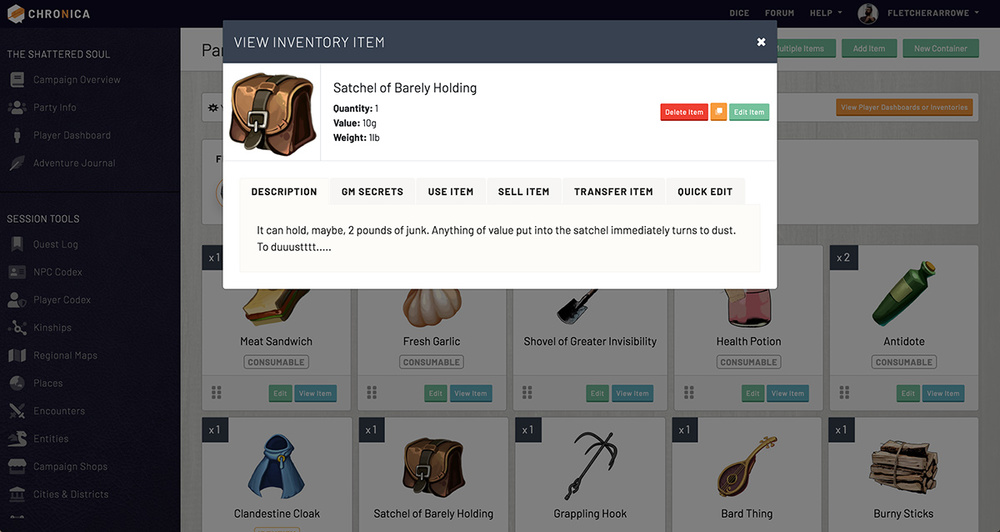 Inventory item details modal
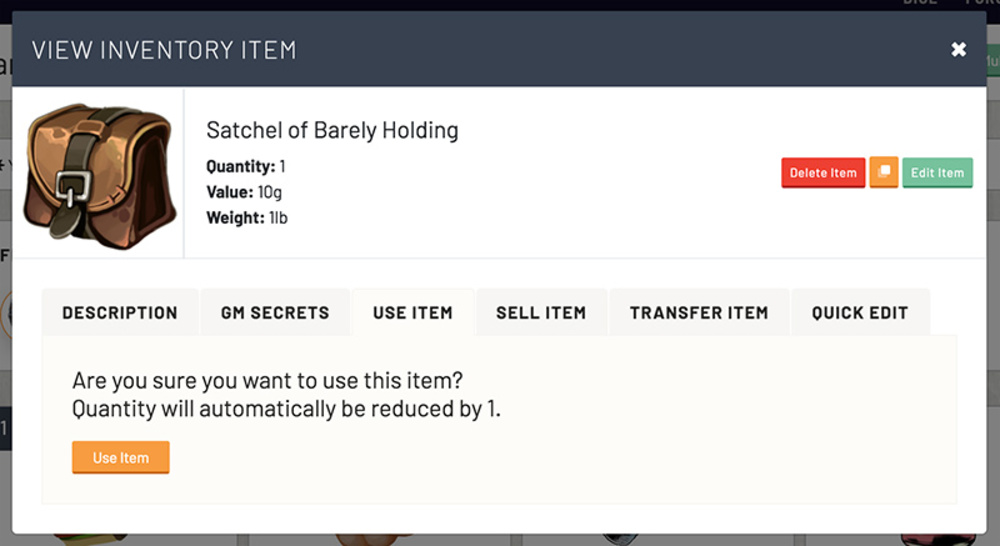 Item view details modal: Use Item tab
 Item view details modal: Sell Item tab
 Item view details modal: Transfer Item tab
9.3 Adding Items
There are three ways to add items.
Add Item — one item, with every detail
- Open the inventory and click Add Item.
- On the New Item tab, fill in the details (below).
- Click Create Item.
- Name and Quantity.
- Item Weight — any text, for example "2 lb". To count towards a container's total weight, it must start with a number. The function will add all weight numbers together, ignoring text. So use the same style of weight for the weight to read correctly, (Ex: all items use lbs: 5lb, 0.5lbs. Instead of 5lbs, 8oz.)
- Container — optional.
- Item Tags — optional labels for quick reference: Attuned, Broken, Consumable, Identify, Mystery, On Display, On Sale, Quest, Sell, Special.
- Currency Price/Value — one box for each currency, for example gold and silver. This is the item's value, and it is the starting amount when you sell it.
- Resource Price/Value — if your campaign uses resources, click Add Resource Price to add one. An item can have several prices, for example 2 gold and 5 lumber. Each is kept separately; Chronica does not convert them into one total.
- Description and an image.
Quick-add Items — several items, just the basics
Click Quick-add Items. Enter up to five items, each with a quantity (it starts at 1), a name and a short description. Rows without a name are ignored. Click Quick-Add Items. These items have no value, tags or container — edit them later to add more.
Copy Item — from the Item Library
- Click Add Item, then the Copy Item tab.
- Click Load Item Library.
- Find the item. Click Quick-copy to copy it with its usual quantity, or View Item to choose a Copy quantity and then click Copy Item.
The Item Library keeps its own copy. If you already have the same item (same name and description), the copy is added to its quantity instead of making a second one:
- Quick-copy always puts the item outside any container, even from a container's + Item. It only adds to a matching item that is also outside a container.
- Copy Item adds to a matching item wherever it is. You can choose a Copy quantity of 0 if you only want the item in your inventory, with none in stock.
9.4 Using, Selling, and Splitting Items
Use an item
Click Use Item at the top of the item window. Chronica takes 1 away from the quantity and records it in the Activity Log. When the quantity reaches 0, the item stays in the inventory with a quantity of 0. Delete it if you no longer need it.
Sell an item
- Open the item in a player, character or party inventory and click the Sell Item tab.
- Choose the Sell quantity.
- Check the Currency payout and Resource payout boxes. They start at the item's value for the quantity you chose. If you change a number, that number is the total you receive for that currency or resource.
- Click Sell Item.
The money goes to the inventory's holder:
- from your Player Inventory — to your own wealth;
- from a character ownership's inventory — to that character's wealth;
- from the Party Inventory — to the party's wealth.
The quantity goes down by the amount sold. An item sold down to 0 stays in the inventory with a quantity of 0.
Split a stack
When an item's quantity is more than 1, you can split it into two stacks — for example, to put some arrows in a quiver and keep the rest in your pack. At the top of the item window, choose how many to move into the new stack and click Split Stack. The new stack appears in the same inventory, outside any container. You must leave at least 1 in the original stack.
9.5 Moving Items Between Inventories
Use Transfer to move items to another inventory. This is also how you give an item to another player, or put it in the party inventory.
Move one item
- Open the item and click the Transfer Item tab.
- Choose the Transfer quantity.
- Under Filter Dropdown, choose which kind of inventory to send it to (below).
- Choose the inventory under Transfer to inventory, and click Transfer Item.
To move a container and everything inside it, use Transfer on the container instead (9.1).
Where you can send items
- Owned Inventories (the default) — the Party Inventory, your own Player Inventory, your characters' inventories, and on paid tiers your own shops and kinship caches.
- Player Inventories — every player's inventory, the Party Inventory, and character inventories. Use this to give an item to another player.
- Campaign Shops and Kinship Caches — on paid tiers. You see the shops you own and the caches of kinships your characters belong to.
You can only move an item out of an inventory you can manage (see 9.0). You can give items to any player.
Good to know
- A moved item leaves its container. At the new inventory it is outside any container.
- If you move part of a stack and the other inventory already has an item with the same name and description, the quantity is added to that item, wherever it is (including inside a container). If you move the whole stack, it arrives as a separate item.
- If an item is priced in a resource that the other inventory cannot hold, Chronica refuses and tells you which resource. Remove that price from the item, or choose another inventory.