
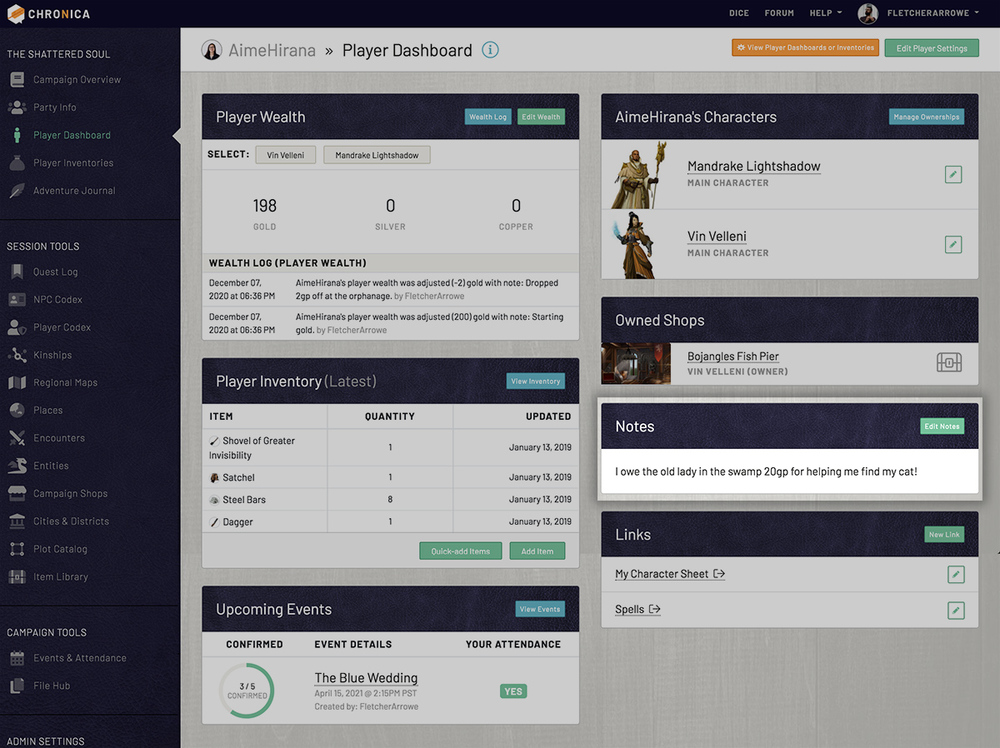
Your Player Dashboard is your own page in a campaign. It brings together the things that belong to you: your wealth, your inventory, your characters, your notes and your links. You have a separate dashboard in each campaign you play in.
To open it, click Player Dashboard in the sidebar.
What is on the dashboard
- Player Wealth & Resources — your money and resources. See 7.2.
- Player Inventory — the items you changed most recently. See 7.3.
- Your characters — every character assigned to you. See 7.4.
- Owned Shops — shops you run, if you are a Shopkeeper. See 7.5.
- Notes and Links — your own notes and bookmarks. See 7.6.
- Upcoming Events and Kinship Caches. See 7.8.
Some panels appear only in some cases. Owned Shops and Kinship Caches appear only on paid tiers. Kinship Caches also appears only when one of your characters is in a kinship that has a cache.
Who can see your dashboard
- You see everything on it.
- Game Masters can open any player's dashboard and see everything on it. They can also change most of it for you, such as your wealth and your inventory.
- Auditors can open any player's dashboard too, but they see less. They see wealth, the wealth log, the inventory, the characters that are not private, and Owned Shops if the player is a Shopkeeper. They do not see your notes, links, events or kinship caches, and they cannot change anything on the dashboard.
- Other players cannot open your dashboard. If they try, Chronica sends them to their own.
 Chronica Player Dashboard screen
7.1 Edit Player Settings
Your player settings control how you appear and what you see in this campaign. They apply to this campaign only.
- On your Player Dashboard, click Edit Player Settings.
- Change the settings you want.
- Click Update Player.
The settings
- Call Name — the name other people in this campaign see for you, in place of your username. Your username is still shown beside it. It can be up to 20 characters. Game Masters can change it too.
- Override Campaign Theme — choose Classic Theme, Nebula Theme or Blacklight Theme to see the campaign in that theme. This changes the theme for you only. Leave it blank to use the theme your Game Master chose.
- Notes — your private notes for this campaign. See 7.6.
Leaving a campaign
To leave a campaign, click the red Leave Campaign button at the bottom left of your settings, and confirm. Chronica then takes you back to your User Dashboard.
When you leave:
- Your characters stay in the campaign and move to the NPC Codex. Any you marked private become visible to the whole party.
- Your published Adventure Notes and the events you created stay.
- Your inventory, wealth, resources, notes and links are deleted, along with your character ownerships and any unpublished draft Adventure Notes.
For the full list, see 6.2 Removing Players. Leaving and being removed have the same results.
The Game Owner cannot leave. For the Game Owner, the Leave Campaign button is greyed out. To close the campaign for good, the Game Owner deletes it from the Edit Campaign page instead.
7.2 Editing Player Wealth
The Player Wealth & Resources panel shows how much money and how many resources you hold. You can change these yourself, so you can keep them accurate during play.
- Edit Wealth — change your money. It appears once the campaign has a currency.
- Edit Resources — change your resources. It appears when there are resources that a player can hold.
If the campaign has no currencies or resources yet, the panel says "Currencies are not set up." See 25.0 Currencies & Wealth.
The wealth log
Every change to your wealth or resources is recorded, with who made it. The panel shows the five most recent entries. Click Full Log to see every entry.
The Full Log shows all your entries together: your own wealth, each of your characters with an ownership, and the shops your characters own. To see only one of them, choose it under Inventory / Ownership. You can also filter by Timestamp After, Timestamp Before and Message Contains. Write dates as yyyy-mm-dd. Then click Search.
Characters with their own wealth
If you have character ownerships, a Select: row appears at the top of the panel. Click Player Inventory to see your own wealth, or click a character's name to see that character's wealth. Edit Wealth and Edit Resources then change the wealth you selected. If some of those characters are Controlled NPCs, they are on a separate Controlled NPCs tab, and your other characters are on the Characters tab. See 8.0 Character Ownerships.
 Edit player and character wealth panel
 Chronica Edit Player or Character Wealth modal
7.3 Player Inventory
The Player Inventory (Latest) panel shows the four items you changed most recently. This includes items inside containers. Each item shows its quantity and the date it was last updated.
- View Inventory — open your whole inventory. You can also open it from Player Inventories in the sidebar.
- Item — add one item, with all of its details.
- Quick-add Items — add up to five items at once, with just the basics.
For moving items, containers, buying and selling, see 9.0 Items & Inventory.
 Player inventory preview panel
7.4 Your Characters
This panel is headed with your name, for example "Rafe's Characters". If you have a Call Name, your username is shown beside it. It lists every character in the campaign that is assigned to you as Player Owner. Each character shows its picture, its name, and its label, such as Main Character or Companion.
Click a character's name to open it. Click the pencil to edit it.
If you control any NPCs, the panel has two tabs. Main Characters lists all your characters except Controlled NPCs. Controlled NPCs lists the NPCs you play.
If no characters are assigned to you, the panel says so and offers a link to create one.
Manage Ownerships
If you play more than one character, each one can have its own inventory and wealth. This is called a character ownership. Click Manage Ownerships at the top of the panel to set them up. Manage Ownerships works only when the campaign has at least one currency. See 8.0 Character Ownerships.
 Player characters panel
7.5 Owned Shops
If you have the Shopkeeper role, the Owned Shops panel lists the shops your characters run. Campaign Shops are a paid-tier feature, so this panel appears only on paid tiers.
Each shop shows:
- Its name. Click it to open the shop.
- Whether it is Open or Closed.
- The character who owns it, and their title.
- A treasure chest. A green chest means the shop's till has money or resources in it. A grey chest means the till is empty. Click the chest to open the till and move the money into your own wealth.
If you are a Shopkeeper but do not run a shop yet, the panel links to Campaign Shops so you can create one. See 19.0 Campaign Shops.
 Player owned shops panel (empty till)
 Player owned shops panel (full till)
7.6 Player Notes & Links
Notes
The Notes panel is a private place for your own notes about the campaign. Only you and the Game Masters can see it. Only you can write in it.
- Click Edit Notes. This opens your player settings.
- Write your notes in the Notes box. You can use @ to mention a quest, character, kinship, place or entity.
- Click Update Player.
Links
The Links panel keeps bookmarks you use often, such as a character sheet, a spellbook or a set of house rules. Only you and the Game Masters can see them.
- To add a link, click + Link. Enter a Title and the Link URL, then click Create Link. Type the full address, starting with
http://orhttps://. A link without it may not work. - Turn on New Tab? if you want the link to open in a new browser tab.
- To change a link, click the pencil beside it, then click Update Link. To remove it, click Delete Link in the same window.
 Player dashboard player notes panel
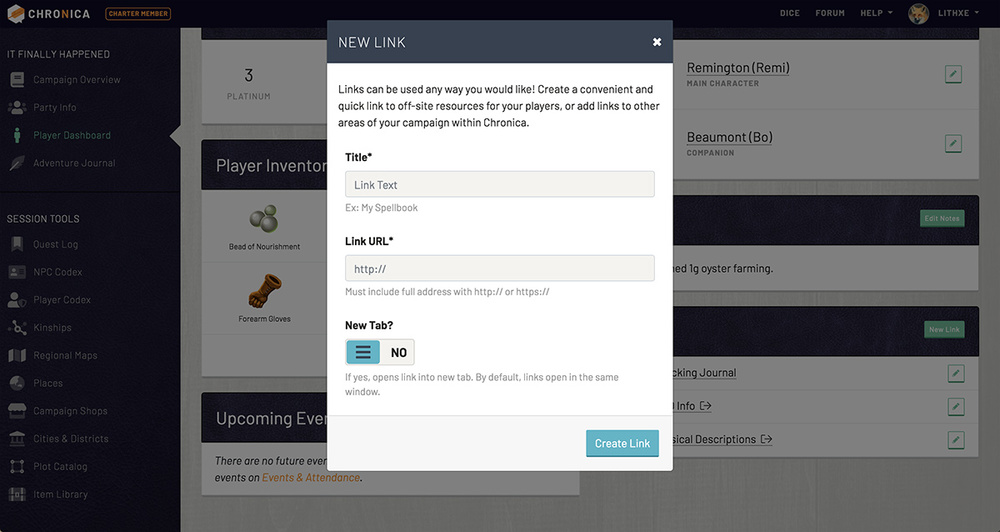 Player dashboard link modal
 Player dashboard links panel
7.7 Other Panels
Upcoming Events
The Upcoming Events panel shows the next three events in the campaign. For each event, it shows:
- How many people have confirmed.
- The event's name, date and time, and who created it.
- Your Attendance — your reply to the event. If you have not replied yet, it shows Unknown.
Click an event to open it and reply. Click View Events to see all of them. See 23.0 Events & Attendance.
Kinship Caches
If one of your characters belongs to a kinship that has a cache, the Kinship Caches panel lists it. Click the cache's name to open it. Kinship caches are a paid-tier feature.
If one of your characters is the Kinship Owner, a treasure chest also appears beside the cache. A green chest means the cache's till has money or resources in it. A grey chest means the till is empty. Click the chest to open the till. See 14.0 Kinships.