
Add an item with "Add Item", or several at once with "Quick-add Items". Each item has a name, quantity, value, image, and notes; saving uses the "Create Item" / "Update Item" button. To edit later, use the green pencil on the card, or the yellow Quick Edit for fast changes.
Bulk actions
When you can manage an inventory, each item card has a checkbox. Selecting items brings up a floating bar with "Move" (into a container), "Delete", and "Deselect" — a quick way to reorganize or clear out many items at once.
9.2.1 Adding an Item
The Add Item screen has a "New Item" tab for building one from scratch and a "Copy Item" tab for pulling one in from your Item Library (click "Load Item Library" to browse). If your campaign uses resource currencies, an item can carry a denomination price and one or more resource prices — add them with "Add Resource Price"; a buyer pays all of them.
9.2.2 View Item Details
Clicking an item opens its details. The header holds actions like "Use Item", "Edit Item", "Split Stack" (when quantity is over 1), "Delete Item", and — for Game Masters — a Clone Item button. Tabs below cover the Description, GM Secrets (GMs), buying or selling, transferring, and Quick Edit.
9.2.3 Use, Sell & Transfer Items
Use reduces an item's quantity as it's consumed. Sell (on personal and party inventories) returns its value to your wealth — note a GM can hide the Sell tab campaign-wide via the "Disable sell tab on inventory items?" setting in Campaign settings. Transfer moves an item to another inventory; the destinations available depend on your role and tier:
- Everyone: Player Inventories, and your own Owned Inventories.
- Paid tiers: Campaign Shops and Kinship Caches (caches you're a member of).
- Game Masters: also Encounters (paid tier) and Quests.
On a shop shelf, an out-of-stock item shows "Sold Out" and one marked view-only shows "Not For Sale".
 Inventory item quick-edit modal
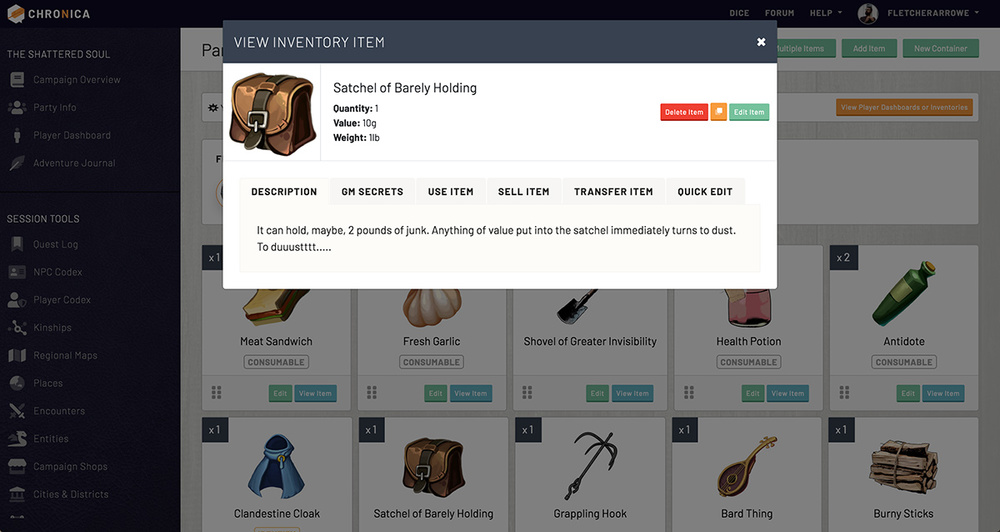 Inventory item details modal
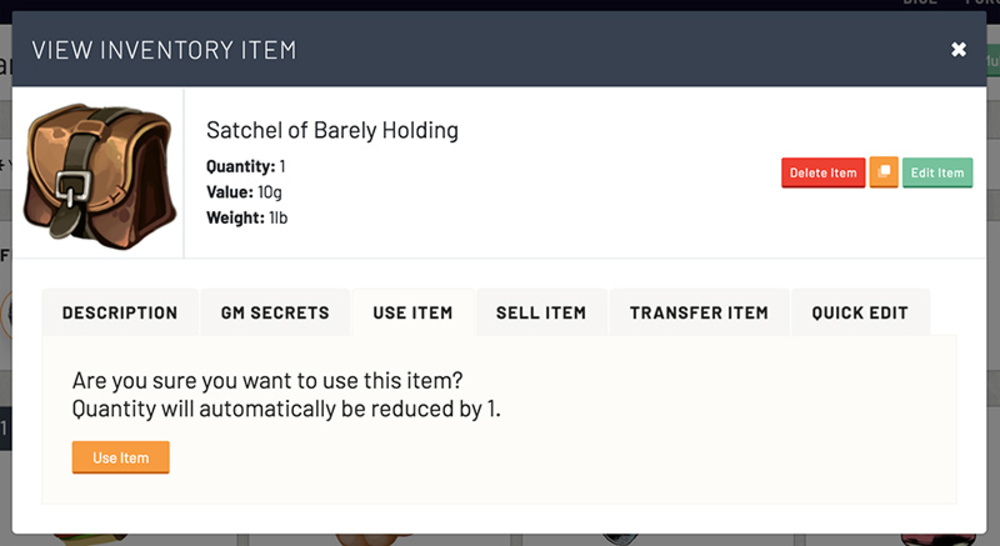 Item view details modal: Use Item tab
 Item view details modal: Sell Item tab
 Item view details modal: Transfer Item tab